CY
CY
CY
CY

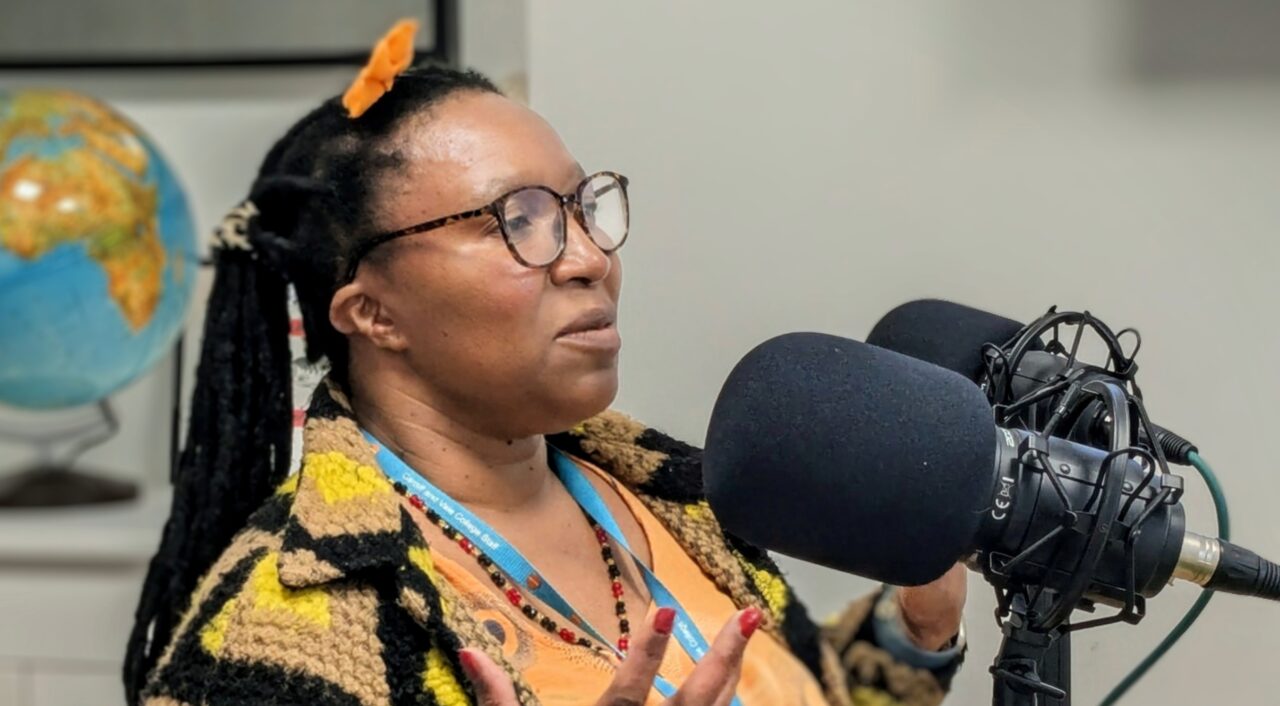
Wales’ Nation of Sanctuary Policy was first published by the Welsh Government in 2019. While Wales doesn’t have its own control over asylum policy (that sits with Westminster), we do have control over many of the things that help people fleeing persecution and danger integrate: education, health, housing, communities, culture. So in January’s episode of the Wales, Africa and the World Podcast, I spoke with Beth Kidd, head of governance and impact at the Welsh Refugee Council and Dr. Numair Masud, co-chair and treasurer of Glitter Cymru about this policy.
We began by asking exactly what the Nation of Sanctuary Policy actually is. Beth explained:
“At its heart, it’s about enabling people to integrate quickly. So one of the key principles is ‘integration from day one’, and it’s enabling them to reach their potential and rebuild their lives.”
She explains what the UK’s asylum policy means for Wales, we welcome about 3,000 sanctuary seekers every year (about 3% of the Principality Stadium in Cardiff). With this, the Nation of Sanctuary Policy aims to make sure they’re able to participate in the economy, promote social cohesion and community stability. So I asked Beth what role the Welsh Refugee Council has:
“The Welsh Refugee Council is there to support people to help navigate systems like accessing education or healthcare or things like that and ensuring that they can rebuild their lives and be the best version of themselves that they can.”
It’s about supporting these people to access language lessons (in Welsh and English), a volunteering programme which lets them use the skills they’ve brought and to practice the language so that if they are given leave to remain, they can hit the ground running.
They’re also there to support after sanctuary seekers’ claims have been heard; helping them into jobs and housing. The Welsh Refugee Council often maintains these relationships for the long term.
They’re there to help these people at their most vulnerable times in their lives and so the trust that they’re able to build is invaluable in enabling that successful integration into Wales. Indeed, around 60% of their staff are former sanctuary seekers themselves and over 30 languages are spoken in the organisation. Beth explains:
“… we’re often the trusted place that people feel understood and accepted and welcome, we quite often get people coming back with queries that actually it’s not for us to help with. But it’s nice that they feel that they’ve got that support there should they need it.”
There have been some significant right-wing attacks on both the Nation of Sanctuary Policy and the Welsh Refugee Council recently; part of a global trend of anti-humanitarianism. Opponents claim it’s a waste of money, charity starts at home, all the usual shallow and morally empty rhetoric that pretends to care about (white) people in this country in order to attack foreigners, black and brown people. Beth explains that despite the good and effective work they and the policy achieves, it is a tiny proportion of the overall Welsh Government budget:
“90% of that budget was spent on the Ukraine programme when the war broke out in Ukraine. So it’s 0.05% of the overall [Welsh Government] budget.”
Despite the relentless millionaire-backed right-wing propaganda, Beth is confident in the innate goodness of people. When I ask her “why” when it comes to giving sanctuary, she explains:
“… it’s that history of welcoming people… we talk about the big Welsh Welcome. It’s just within people’s DNA, I think, to see people as other humans and not as numbers or statistics… and Wales has been through tough times, right? And I think often the more you’ve experienced, the easier it is to relate to somebody else.”
That last line from Beth is profound and speaks to the wider global solidarity movement. In December’s episode we welcomed Amber Demetrius from the Welsh Centre for International Affairs to talk about Global Citizenship. Amber’s work is about helping young people experience the wonderful variety and richness of the world. To give them the experiences they need to understand and to relate the fact that we’re all part of a global community, and the responsibility we have to each other.
Numair’s own lived experience is an invaluable addition to this episode, as a former sanctuary seeker and now refugee. He agrees with Beth and explains that in his home of Pakistan, he was unable to live openly as a gay man, and crucially unable to openly live with his life–partner (then-fiancé and now husband, who is from Nigeria).
Both countries are former British colonies but are still hurting from that legacy. In this particular regard the anti-homosexuality laws which threatened Numair’s existence are themselves colonial imports, imposed by the British. He explains the complexity of being an LGBTQ+ man and the unique intersectional difficulties that brings with also being a refugee:
“… being a gay refugee, or a gay asylum seeker, as I was in 2015, is something that isn’t spoken about a lot…. there are over 60 countries today in the world that have anti-LGBTQ+.
“So my story is one that is, I’d like to believe, very human. And at the same time, I think it reminds us of the complex intersectionality between protected characteristics, that you could be a sanctuary seeker and you could also be LGBTQ+, so you can sometimes experience the amplified discrimination of that intersectionality.”
I asked Numair to unpack a bit more his own personal experience with the Nation of Sanctuary, how did he interact with it, what led to his claim for sanctuary:
“I came to the UK as an undergraduate student at the University of Bristol… and I didn’t really feel that welcome in England, to be perfectly honest. I really struggled to make friends. I remember being the only non-white person in my class when I was studying zoology. I remember, you know, people drawing weird things about me in my dorm, you know, on the wall. I recall not feeling particularly welcome. And so I went back to Pakistan.”
It was in Pakistan that Numair realised two things: one, that he loved science and wanted to be a scientist and two, there was no way he’d be able to live openly. He returned to the UK and this time came to Wales, pursuing a master’s degree and then a PhD at Cardiff University.
“… it’s really during my master’s that I started to explore being a gay man with relative freedom… We take freedom for granted. And that freedom, so many people are deprived of [it]. I felt that Welsh Welcome.”
It was at this point that Numair applied for asylum and eventually was granted sanctuary. He now lives freely and openly with his husband and with his experience, is now the co-Chair and treasurer of Glitter Cymru. Numair recounts its origins:
“I met Vishal Gaikwad… and we were talking about how difficult it is for minoritised LGBTQ+ people to find a community. And my goodness, the amount of overt racism you experience online… And so Vish suggested that they wanted to start a group for minoritised LGBTQ+ people.
“It sort of formally came into existence in 2016, with really three or four people and since has really blossomed to become, I would argue, Wales’ largest LGBTQ+ global majority community. And what it represents is the sort of Welsh community spirit of togetherness. It is there to provide social and community support to minoritised people.”
Glitter Cymru is doing some invaluable work at that intersection of sanctuary seeking and LGBTQ+. Through community-level activism they provide social integration support, practical support such as with food vouchers, housing dignity support. Numair summarises the position of many sanctuary seekers:
“What we all want to do as human beings, as sanctuary seekers, is to integrate, to belong.”
Glitter Cymru’s work was recognised last year at the Welsh Refugee Council’s Nation of Sanctuary Awards – the Equalities Champion Award due to being entirely volunteer-led and operating in that intersectional space; becoming invaluable advocates and supporters for a very vulnerable group of people. Recalling winning the award, Numair tells me:
“It really was an amazing night because for me, at a personal level, I was there with my husband… It’s about realising how important it is to appreciate the work of, as you say, volunteers all over Wales. Because… I’m doing this because it is the right thing to do. These are human beings that we are helping, and it is something that I get such personal, moral, ethical fulfillment from. And I encourage more people to operate in that space.”
The topic of sanctuary is closely aligned with the concept of global solidarity and the work Hub Cymru Africa does. Global solidarity is about recognising and taking action in the global community. To realise that issues or problems far away affect us. That as part of a global community we have a responsibility to each other.
The conversation moves on to the challenges facing sanctuary in Wales. The country is going to the polls in May as we elect a new Senedd (Welsh Parliament). I ask my guests what’s at stake for Wales’ commitment to solidarity and sanctuary. Beth argues:
“If we lose the nation of sanctuary vision, it will be a massive backward step morally, socially and economically as well. And I think people need to understand that and think hard about whether that’s something they really want.”
Numair adds:
“I think for me, for Glitter Cymru, for all sanctuary seekers, what is at stake is human lives, nothing more or less than human lives, because that’s what we’re talking about today. We’re talking about human beings.”
Numair also makes an astute point, bridging that false divide between people already here and sanctuary seekers. He elaborates:
“The difference between a sanctuary seeker and a British national is often a piece of paper, a document… All it takes is for people in power to suddenly realize that their interests don’t align with your interests. And suddenly that piece of paper doesn’t matter as much.”
I didn’t want the conversation to end under a dark cloud of threat, so I asked Beth and Numair what gives them hope.
Beth answers that for her it’s young people, realising their agency and taking action to make their community, country and world better. The resilience of people too gives her hope, and the little wins which have a big impact. She recalls speaking to one sanctuary seeker recently:
“I was speaking to somebody the other day who said they haven’t bought a wardrobe since they’ve had [refugee] status for a couple of years… And even though they’ve now got a stable home, they still can’t bring themselves to stop living out of a suitcase because of the hostile environment and the sense that it will be taken away from you at a moment’s notice.
“But they’ve recently got another job and they’re thinking about maybe buying a wardrobe and that’s… It gives me hope that eventually everybody will be able to feel that way, that they are here and they’re safe and that they can relax.”
Numair answers by asking what the alternative is:
“What is the alternative to hope? Despair. We don’t have a choice to indulge in that… And I think Glitter Cymru is an example of a community support group that is trying to do that.”
Wales’ Nation of Sanctuary Policy is borne out of the fundamental and intrinsic values: empathy, kindness, the aspiration for safety, prosperity and a better world for everyone. But the reality is the world isn’t universally kind, safe or prosperous. When your family is in need, you help them. When flooding hits your neighbouring village, you donate food and supplies to the victims. When people are persecuted and their lives are threatened just for existing, we give them sanctuary.
Listen to the full episode and Beth and Numair’s insights in their own words on the Wales, Africa and the World Podcast on your favourite streaming service or on the Hub Cymru Africa website.
The Welsh Refugee Council has for 35 years, been supporting sanctuary seekers in Wales to build new futures in Cymru.
The Welsh Refugee Council’s Nation of Sanctuary Awards are currently accepting nominations, which are open until the 14th of February covering ten categories including volunteer of the year, young person of the year, and more!
Glitter Cymru is an LGBTQ+ community group supporting LGBTQ+ global majority individuals including asylum seekers and refugees. Get in touch with Glitter Cymru to get involved with their work at glittercymru@gmail.com.